
Most organisations deliver some form of team training, but let’s be honest: a lot of it doesn’t lead to real change. People attend the session, feel motivated for 24 hours, then go straight back to doing things the way they always have.
The problem isn’t that training doesn’t work. It’s that much of it is delivered in a way that can’t create lasting behaviour change.
If you want to know how to conduct team training that people genuinely learn from, training they remember, use, and build confidence from, you need more than a PowerPoint deck and a room full of people. You need structure, relevance, and a clear connection between the training content and the real problems your teams face.
At Think Sigma, this is exactly how we approach training: practical, tailored, and designed to solve real business challenges. In this blog, we’ll walk through what makes team training truly effective and how to deliver sessions your people will actually learn from.
Why Most Team Training Fails
Before we look at how to conduct team training, it helps to understand what goes wrong in traditional approaches. Most training fails because:
- It’s generic: Content doesn’t relate to people’s daily work.
- It’s passive: Too many slides, too little interaction.
- It has no clear purpose: People don’t know why they’re there.
- There’s no follow-up: Learning fades without reinforcement.
- It ignores real challenges: Training doesn’t connect to the problems people need to solve.
If the training feels irrelevant or theoretical, people disengage and the session becomes a tick-box exercise rather than a capability-building opportunity.
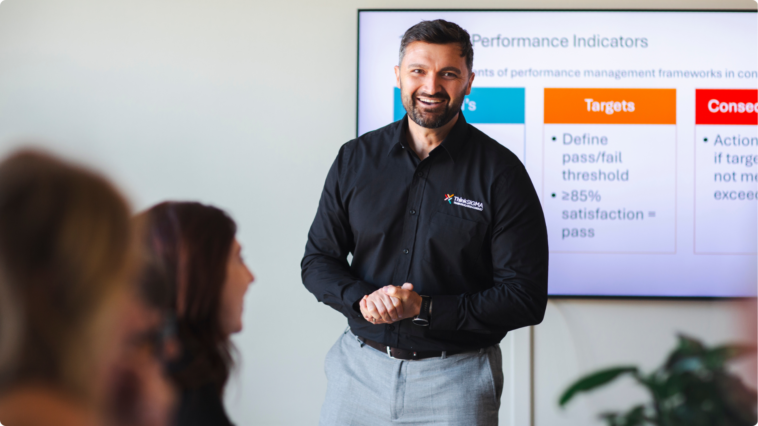
How to Conduct Team Training That Actually Works
Based on years of experience delivering interactive, high-impact workshops, here are the essential elements of team training that people genuinely learn from.
1. Start With the Problem, Not the Topic
One of the most overlooked aspects of how to conduct team training is understanding the real issue you’re trying to solve. Effective training doesn’t begin with “We need a workshop on X.”
It begins with:
- What’s not working right now?
- What skills or knowledge gaps are creating challenges?
- What behaviours need to shift?
- What outcomes do we want to see after the session?
When training starts with the real problem, it becomes immediately relevant and relevance is what makes learning stick.
If poor commercial decision-making is one of your challenges, explore Think Sigma’s Commercial Awareness Training, built around your real-world scenarios.
2. Make It Practical, Not Theoretical
A core principle of how to conduct team training effectively is making it practical, not theoretical. People learn best by doing, not by listening for hours.
Practical training gives teams the chance to:
- Test ideas
- Use tools
- Solve problems
- Apply new thinking
- Try out skills in a safe environment
Theory has its place, but it should only be a small part of the session. What matters is practical, hands-on experience where people can immediately see how the content applies to their job.
3. Use Real Examples From Your Organisation
One of the most effective ways to improve learning outcomes is to incorporate internal scenarios, processes, mistakes, opportunities, and customer interactions into the sessions.
People remember content that feels familiar.
If you want to know how to conduct team training that humans actually engage with, start with something they care about:
- A project that went off track
- A decision that cost the business time or money
- A customer complaint
- A cross-team conflict
- A process that creates frustration
When training reflects real experiences, people pay attention and the learning becomes instantly meaningful.
Our Commercial Awareness Training is built around your cases, your numbers, and your decisions, ensuring relevance from start to finish.
4. Create a Safe Space for Questions, Discussion, and Challenge
Training shouldn’t feel like a lecture. It should feel like a conversation. The most valuable insights often emerge when teams:
- Ask questions
- Challenge assumptions
- Reflect on decisions
- Share frustrations
- Explore alternatives
Psychological safety is essential. People need to know that the room is a place where they can speak honestly without judgement. Training without discussion is rarely training, it’s just information delivery.
5. Mix Learning Styles to Engage Everyone
Not everyone learns the same way. Effective training sessions incorporate:
- Visual content
- Verbal explanation
- Group discussion
- Hands-on activities
- Practical scenarios
- Reflection time
When sessions appeal to multiple learning styles, engagement increases and content is retained for longer.
6. Focus on Behaviour Change, Not Just Knowledge
Understanding how to conduct team training that leads to behaviour change is what separates effective sessions from forgettable ones. Knowledge is easy to teach. Behaviour change is harder, but far more valuable. Effective team training helps people shift how they:
- Make decisions
- Prioritise tasks
- Communicate with colleagues
- Approach risks
- Solve problems
- Manage complexity
If people leave the session knowing more but doing nothing differently, the training hasn’t worked.
7. Reinforce Learning After the Session
One session is never enough. Learning fades quickly unless it’s reinforced. To ensure long-term impact, include:
- Action plans
- Follow-up check-ins
- On-the-job application
- Coaching conversations
- Leadership modelling of the behaviours taught
Reinforcement is the piece most organisations forget and it’s the piece that determines whether training has an actual impact.
8. Measure the Impact of the Training
To know whether your approach to how to conduct team training is working, you need to measure outcomes. That includes:
- Improvements in behaviour
- Increased confidence
- Better decision-making
- Fewer mistakes or escalations
- Faster delivery
- Clearer communication
- Stronger collaboration
Training isn’t successful because people enjoyed it. It’s successful because it changed something that matters.
Want your people to make better commercial decisions? Our tailored Commercial Awareness Training delivers measurable improvements in capability.
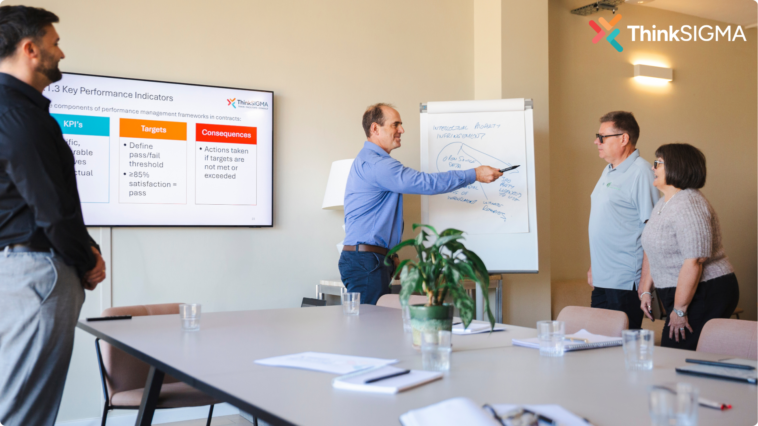
What Great Team Training Looks Like
When you master how to conduct team training that feels relevant, practical, and psychologically safe, you create teams that think better, communicate better, and work better together.
When organisations get team training right, it creates visible change:
- Meetings become more productive
- Teams collaborate instead of competing
- Decisions are made with clarity and confidence
- People take ownership instead of waiting for direction
- Communication improves
- Mistakes reduce
- Performance increases
Your teams don’t just feel trained, they feel equipped.
Building Team Training That Creates Real Capability
The best training is training that people remember, understand, and use. It aligns with real challenges, encourages collaboration, and empowers people to think differently about the work they do every day.
If you want to deliver training that actually leads to better decisions, stronger communication, and real business impact, the secret is simple:
Focus on relevance, practicality, behaviour change, and reinforcement.
Team training should feel like an investment, not an interruption.
If you’re ready to improve commercial decision-making across your teams, talk to Think Sigma about our practical, tailored Commercial Awareness Training programmes.


